
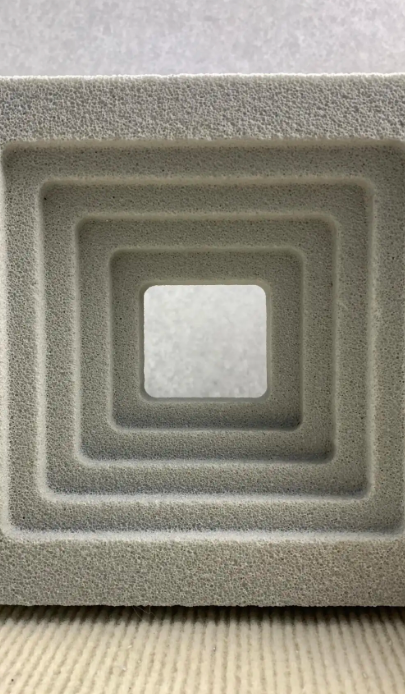
Thermal Insulation Performance of 3D Foam Ceramic Tile
How Microstructure Affects Conductive and Convective Heat Transfer
What makes 3D foam ceramic tiles so good at resisting heat? Well, it all comes down to how they're built with those special porous structures. When we look at open cell foams, they form these little air pockets that basically block heat from moving through them by conduction. And those ceramic parts? They don't let much radiation pass either because they reflect most of it back instead of absorbing. Lab tests from around 2019 showed these materials can have thermal conductivity between 0.07 and 0.10 W/m·K which is about 40% better than regular insulation materials. Some versions with closed cells work even better against convective heat loss since each air pocket is sealed off separately. But there's a tradeoff here too - those closed cells aren't as good for letting moisture escape. The best results happen when manufacturers get the right balance between pore sizes (usually somewhere between 100 to 500 micrometers) and strut thicknesses. Getting this right means maximizing the R-value while still keeping the material strong enough and allowing some airflow through it.
Direct Comparison: 3D Foam Ceramic Tile vs. EPS, Mineral Wool, and Aerogel
Independent thermal testing highlights how 3D foam ceramic tile occupies a unique niche among insulation materials:
| Material | Thermal Conductivity (W/m·K) | Service Temperature | Moisture Resistance |
|---|---|---|---|
| 3D Foam Ceramic Tile | 0.07–0.10 | ≥1200°C | Excellent |
| EPS | 0.033–0.038 | ≥75°C | Poor |
| Mineral Wool | 0.035–0.040 | ≥600°C | Moderate |
| Aerogel | 0.013–0.018 | ≥400°C | Good |
Aerogel does have the edge when it comes to conductivity numbers, but there's a catch. Above around 400 degrees Celsius, these materials start breaking down and need special protection coatings to work properly. Ceramic foam tiles tell a different story altogether. These 3D structures stay strong even when exposed to blistering heat levels that would melt most polymer and fiber insulation materials completely. What really stands out is how they handle moisture problems. The open cell design prevents water damage from affecting performance, unlike expanded polystyrene or mineral wool that lose most of their insulating power once wet. For industries dealing with intense heat environments, kilns requiring lining solutions, or buildings needing retrofits in places with lots of humidity, this material offers something special. It combines heat resistance with fire safety features and maintains its properties over time despite changing weather conditions.
Key Structural Factors Influencing 3D Foam Ceramic Tile Efficiency
Open-Cell vs. Closed-Cell Pore Architecture and Its Impact on R-Value
The way pores are arranged really affects how materials handle temperature changes and moisture movement. When we look at closed cell structures, they trap air inside those sealed pockets which cuts down on both types of heat transfer. Tests done according to ASTM C518 standards show these can actually boost insulation performance by around 40% compared to their open cell counterparts from last year's data. But there's a trade off here too. These closed cells don't let water vapor pass through as easily, so builders need to be extra cautious when incorporating them into walls otherwise condensation might form between layers. On the flip side, open cell designs do let some moisture move through but they can create problems with air circulation unless all edges are tightly sealed during installation. This makes proper detailing absolutely critical for successful building envelope design.
| Pore Type | Avg. R-Value | Moisture Permeability | Best Application |
|---|---|---|---|
| Closed-Cell | R-5.2/inch | Low | High-humidity zones, exterior sheathing |
| Open-Cell | R-3.7/inch | Moderate | Ventilated wall systems, acoustic-thermal hybrids |
For exterior applications where thermal bridging and condensation risk are primary concerns—such as coastal retrofits or industrial cladding—material scientists consistently recommend closed-cell formulations paired with compatible vapor management layers.
Sintering Parameters and Phase Composition Effects on Thermal Resistance
The way we control the sintering process has a major impact on what kind of crystal structures form, how dense the material becomes, and whether pores remain after treatment. All these factors affect how well the material resists heat transfer. When temperatures go above about 1300 degrees Celsius during sintering, the result is usually a very dense mullite structure, but this comes at a cost. The porosity drops by around 22%, which actually makes the material worse as an insulator. Studies have shown that keeping things around 1150 to 1250 degrees for about 90 minutes works best. At those temperatures, both cristobalite and cordierite crystals develop nicely without losing too much of their original pore structure, maintaining over 75% of the initial void space. This approach gives roughly 18% better thermal resistance compared to standard sintering methods. Adding tiny particles of zirconia helps scatter heat-carrying vibrations and breaks up the paths through which heat would normally travel. Looking at phase maps reveals something interesting too. Materials where cordierite spreads evenly throughout tend to maintain consistent conductivity levels around 0.08 W per meter Kelvin. This beats mineral wool's usual range of 0.035 to 0.040 W/mK when completely dry, but even more importantly, performs far better when exposed to typical moisture conditions found in actual applications.
Real-World Application Evidence for 3D Foam Ceramic Tile
Mediterranean Retrofit Case Study: Measured U-Value Reduction and Moisture Performance
Over five years, a retrofit project was carried out on twelve old masonry buildings located in southern Spain, showing pretty good results in real world conditions. Buildings treated with these special 3D foam ceramic tiles had average U-values around 0.22 W/m²·K, which is about 32 percent better than similar buildings that used regular mineral wool insulation. Thermal images taken during the study showed that those pesky cold bridges at windows and where different parts of the building meet were completely gone. Even though the area gets really humid most of the time (around 85% humidity), the tiles only absorbed less than 5% moisture after three straight rainy seasons. The R-value stayed strong too, and there wasn't any peeling or flaking on surfaces. People living in these buildings didn't report any mold growing behind the insulation either, probably because the material lets vapor pass through but repels water. Workers who installed the tiles found them easier to work with on curved walls compared to stiff board materials. After watching these buildings for all sixty months, nobody saw any drop off in how well they insulated against heat loss.
Practical Considerations: Cost, Durability, and Installation of 3D Foam Ceramic Tile
Looking at 3D foam ceramic tile needs more than just thinking about what it costs initially. Sure, each piece typically costs 30 to maybe even 50 percent more than regular stuff like mineral wool or EPS insulation. But these tiles last way longer too - over fifty years in places where there's not much wear and tear. No one has ever seen them degrade when exposed to temperatures under 1000 degrees Celsius either. These ceramic tiles are completely fireproof according to ASTM standards, so they don't catch fire or release toxic smoke during fires. They also handle freezing and thawing cycles without developing tiny cracks that let heat escape. Putting these tiles in place takes some careful work though. Contractors need special diamond cutters for clean edges, surfaces must be perfectly level using lasers to avoid stress points forming later on. And there's this special mortar mix that sticks really well while allowing for expansion differences between the ceramic material and whatever surface it's going on top of, whether concrete or steel structures. As long as installers follow all those manufacturer instructions about joints and primer application, this whole system works great with almost zero maintenance needed in tough conditions ranging from industrial furnaces to tall buildings located in earthquake-prone areas.