
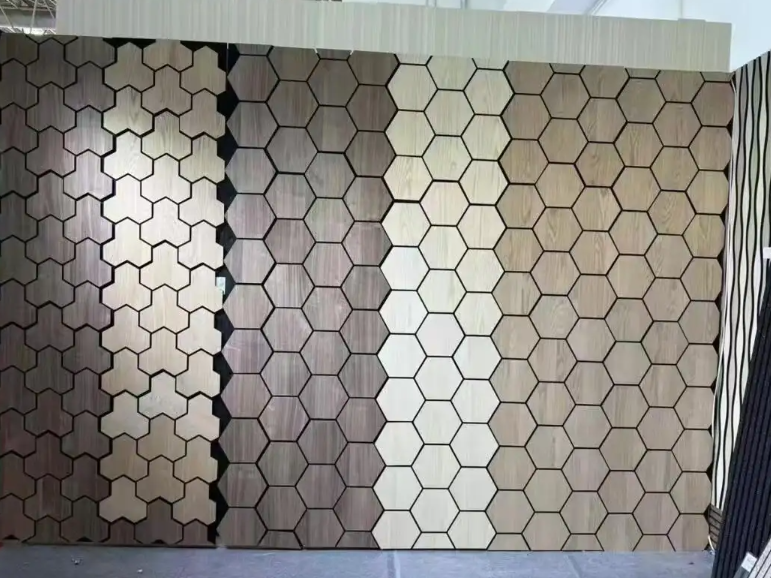
Acoustic Performance of Polyester Soundabsorbing Panel in Office Environments
Frequency-Specific Absorption: Why Polyester Excels for Speech-Focused Mid-to-High Frequencies
The human voice typically falls within the 500 to 4000 Hz range, right where office noise gets most distracting and our brains start working harder to process sounds. Polyester panels work really well in this area because they have all these tiny fibers packed together that trap sound waves and turn them into heat energy through friction. Mineral wool works better for lower frequencies, but polyester is specially designed to tackle those middle ranges where people actually talk. The material absorbs speech sounds quite effectively even when installed only a few inches thick. This helps cut down on how clearly coworkers can hear each other across desks, which is one of the main reasons offices feel so noisy. Studies back this up, including measurements taken according to ISO standards for how sound bounces around in workplaces.
NRC Ratings Explained and Real-World Impact on Speech Clarity in Open-Plan Offices
The Noise Reduction Coefficient, or NRC for short, works as a standard measurement scale ranging from 0 to 1 that looks at how well materials soak up sound across four key frequencies important for speech understanding these are around 250 Hz, 500 Hz, 1 kHz, and 2 kHz. When it comes to polyester acoustic panels, most of them hit pretty high marks on this scale usually somewhere between 0.8 and 1.0. That basically means they can grab about 80 to even 100 percent of the sound bouncing around those specific ranges. Real life tests have shown something interesting too when spaces install just 15 to 20 percent coverage of walls and ceilings with panels rated at NRC 0.9, people notice a drop in echo times by as much as 60 percent. This makes a big difference in reducing that annoying background chatter known as the cocktail party effect where everyone talks over each other. Looking at actual field data from various businesses after installation, there tends to be around 5 to 7 decibel drops in general noise levels which feels like cutting down on half the overall volume. And what's really cool? These quieter environments actually help people focus better studies indicate an average improvement of about 18 percent in maintaining attention according to proper cognitive testing methods.
Practical Office Applications of Polyester Soundabsorbing Panel
Case Study: Measured Noise Reduction and Productivity Gains in a 200-Person Open-Plan Office
A manufacturing firm deployed polyester soundabsorbing panels across ceilings and workstation partitions in its 200-person open-plan office to address chronic speech interference. Pre-installation reverberation time measured 1.22 seconds—well above the ANSI/ASA S12.60-recommended maximum of 0.6–0.8 seconds for speech intelligibility. Post-installation results showed:
- Reverberation time reduced to 0.82 seconds (32% improvement)
- Employee-reported distractions fell by 28%
- Task completion rates rose 15% within six months
Crucially, the panels’ mid-frequency absorption profile suppressed overlapping vocal energy without over-damping—preserving natural speech warmth while eliminating echo buildup. This balanced acoustic correction coincided with an 11% decline in stress-related absenteeism, reinforcing how precisely targeted material selection supports both performance and occupant well-being.
Targeted Deployment in Conference Rooms, Phone Booths, and Hybrid Workspaces
Polyester panels deliver highest impact when placed where speech clarity and privacy are mission-critical—not uniformly across all surfaces. Strategic deployment yields rapid ROI:
- Conference rooms: Panels mounted behind presenters reduce reverberation by up to 50%, eliminating echo for remote participants and meeting ANSI S12.60 speech transmission index (STI) thresholds for intelligibility
- Phone booths: Full-wall coverage achieves 45–50 dB speech privacy (per ASTM E90), preventing leakage into adjacent zones
- Hybrid workstations: Overhead panels cut ambient chatter by 8–10 dB during video calls—enough to meet Zoom and Microsoft Teams’ recommended background noise thresholds (<40 dB SPL)
Because polyester absorbs efficiently per unit area, optimal performance often requires minimal coverage: just 20% surface treatment in conference rooms achieves target 0.6-second reverberation, while most phone booths need only 3–4 panels for full containment.
Critical Non-Acoustic Considerations for Polyester Soundabsorbing Panel in Commercial Offices
Fire Safety (ASTM E84 Class A), Low-VOC Compliance, and Indoor Air Quality Certifications
When it comes to commercial office spaces, acoustic materials need to do more than just control noise levels. They also have to meet strict requirements for fire safety and indoor air quality. Take polyester sound absorbing panels for instance. These need to pass the ASTM E84 Class A test, which basically means they won't spread flames beyond 25 units or produce more than 450 units of smoke when exposed to fire. But there's another important factor too. Low VOC performance matters a lot because poor quality products release harmful chemicals into the air over time. This can lead to sick building syndrome symptoms among occupants. Look for panels that carry certification under CDPH Standard Method v1.2 or GREENGUARD Gold standards. These ensure formaldehyde levels stay below 5 micrograms per cubic meter and total VOCs remain under 0.5 parts per billion. Additional third party certifications such as LEED IEQ Credit 4.1 or the WELL Building Standard W09 provide extra assurance that these materials align with current health and safety expectations. For businesses looking ahead, polyester panels represent a smart investment that meets today's regulations while preparing for tomorrow's demands in occupied environments.
Polyester Soundabsorbing Panel vs. Common Alternatives: When to Choose It— and When Not To
When looking at office spaces where people need to hear each other clearly, stay healthy, and maintain green credentials, polyester sound absorbing panels come out on top. These panels typically hit an NRC rating between 0.8 and 1.0 across frequencies from 500 to 4000 Hz. Plus they meet Class A fire standards according to ASTM E84, comply with CDPH v1.2 for low VOC emissions, and can be fully recycled after use. That puts them well ahead of traditional options like fiberglass and mineral wool when designing spaces for human comfort. But there's a catch worth mentioning here. They don't perform as well at frequencies below 250 Hz which makes them less suitable for factories or places with heavy machinery noise or vibrating HVAC systems. In typical office layouts, meeting rooms, and those modern hybrid work areas where most sounds are voices talking back and forth, polyester panels really shine. They control acoustics better than most alternatives while contributing positively to overall workplace wellness. If someone absolutely needs to absorb those deeper bass frequencies though, mineral wool still works fine for that purpose. Still, swapping it into speech oriented commercial spaces might mean sacrificing important aspects like indoor air quality, fire protection standards, or long term environmental goals.
Table of Contents
- Acoustic Performance of Polyester Soundabsorbing Panel in Office Environments
- Practical Office Applications of Polyester Soundabsorbing Panel
- Critical Non-Acoustic Considerations for Polyester Soundabsorbing Panel in Commercial Offices
- Polyester Soundabsorbing Panel vs. Common Alternatives: When to Choose It— and When Not To